“Let us pray for the elderly, that they may become teachers of tenderness so that their experience and wisdom may help young people to look towards the future with hope and responsibility.”Jun 30, 2022
"Pope Francis has asked the Catholic Church to pray in a special way for the elderly during the month of July."
"The prayer intention follows requests to pray for families in June and for young people in May, and coincides with the celebration of the World Day for Grandparents and the Elderly on July 24."
“We cannot speak about family without talking about the importance of the elderly among us,” Pope Francis said in a video message released June 30.
‘We elderly people often have a special sensitivity for care, for reflection, and affection,” he noted. “We are, or we can become, teachers of tenderness.”
"I do so love St Peter,” says a friend of mine. “Whenever he opens his mouth, he puts his foot in it” She is right, of course. Whatever else St Peter may be, he is not the model of a wise and noble hero. He walks on the water – but then panics and starts to sink. He makes the first profession of faith – and moments later blunders into error and is called Satan by the Lord. He refuses to be washed, and then, when the purpose is explained to him, demands to be washed all over. And, of course, he betrays his master soon after having been warned that he will and having sworn not to. If Peter is the rock on which the Church is built, what a fissured and friable rock it is! How much better, we think, to have chosen the Sons of Thunder, for their energy; or Judas Iscariot, for his financial acumen; or John, because he was loved the best. The choosing of Peter teaches us a lesson. The Church’s foundation-stone and its first leader is not all-wise, all-knowing, good, heroic, and beautiful. He is a very ordinary man who makes about as many mistakes as we would in his place, and kicks himself for them just as thoroughly afterwards. If St Peter had been a hero, we could easily have despaired of ever becoming like him. If St Peter had been great, and noble, and good, we could have told ourselves that the Church is for the saints, despaired, sat down, and not bothered. But the Church is not just for saints: it is for confused, impetuous, cowardly people like us – or St Peter. The rock crumbles, the ropes are frayed, the wood is rotten – but, although that improbable building, the Church, is made of such inferior materials, it grows (on the whole) faster than it collapses, and it is grace that holds it together. In the end, it was grace that gave the coward the courage to bear witness when it counted, grace that gave the fool the wisdom he needed to set the infant Church on her way, grace that taught the impetuous man patience and forbearance. We none of us admire ourselves, however much we would like to; let us not try to admire St Peter either, but admire instead the grace he was given, and pray that, weak as we are, we may be given it too, and may use it.See the article in the Catholic Encyclopaedia."
Site Ref: https://universalis.com/20220629/today.htm
St Paul
"St Paul is not an attractive figure today. We are still knee deep in the overripe fruit of late romanticism: we admire men who feel, not think; who enchant people into following them, not argue them into submission. There is even, nowadays, a fashion for saying that Paul invented Christianity as we know it, that he set out with the cynical aim of fashioning an enduring institution; and that the real Christianity, the Christianity of Christ, is something quite different from and far nicer than the Christianity we know. Yes, Paul’s mind did shape the early Church. Yes, without him things would have been different. And all the information that we have in the New Testament is entirely consistent with the whole thing being a Pauline conspiracy. But so what? “Consistent with” is a treacherous phrase. The evidence of my eyes is entirely consistent with there being an invisible lion in my fireplace, because you can’t see invisible lions; but I still don’t believe there is one. I trust the world, I have faith in it, and invisible lions are not part of that faith. I trust God, I have faith in the Holy Spirit – I say so out loud on Sundays – and I believe that God called Saul because he needed him, and that the renamed Saul did and said what needed to be said and done. Paul is not some cold and remote intellectual – just read the Epistles, and see if that stands up. Paul is always reminding people of his weakness – look, I know what I ought to do, and I keep on doing the opposite – look, I have this thorn in my flesh and God absolutely refuses to take it away. Paul is not all mind – he does have his troubles too. But yes, Paul does have a mind, and that raises problems in an age that doesn’t, that uses “clever” as a term of abuse. Remember, though, that we are commanded to love the Lord our God with all our heart, with all our soul, with all our mind, and with all our strength. Perhaps we cannot love St Paul very much nowadays; but let us at least pray for the grace to love God with our minds, as he did. See the article in the Catholic Encyclopaedia."
Site Ref: https://universalis.com/20220629/today.htm
~~~
Did you know??? The reason we celebrate their Feast Days on the same day... Answer: Peter and Paul's day is the feast day that honor the martyrdom of the two saints, sometime between AD 64 and 68. While the church recognizes that they may not have died on the same day, tradition says that this is the day that they were both martyred in Rome by Emperor Nero. Site Ref: the roman guy.com
~~~
Thank you St. Peter and St. Paul for choosing to follow Christ
Each year Jesus’ parents went to Jerusalem for the feast of Passover, and when he was twelve years old, they went up according to festival custom. After they had completed its days, as they were returning, the boy Jesus remained behind in Jerusalem, but his parents did not know it. Thinking that he was in the caravan, they journeyed for a day and looked for him among their relatives and acquaintances, but not finding him, they returned to Jerusalem to look for him. After three days they found him in the temple, sitting in the midst of the teachers, listening to them and asking them questions, and all who heard him were astounded at his understanding and his answers. When his parents saw him, they were astonished, and his mother said to him, “Son, why have you done this to us? Your father and I have been looking for you with great anxiety.” And he said to them, “Why were you looking for me? Did you not know that I must be in my Father’s house?” But they did not understand what he said to them. He went down with them and came to Nazareth, and was obedient to them; and his mother kept all these things in her heart.
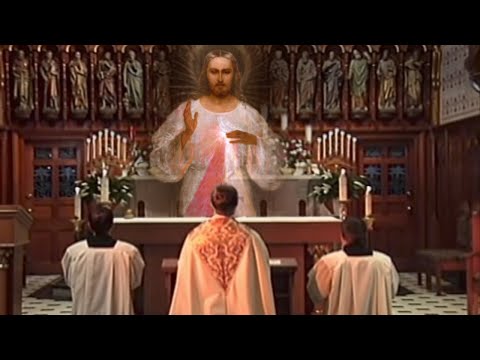
Shares his thoughts about the Sacred Heart of Jesus
"As a nondenominational pastor, David Sanborn understood the idea of the love, mercy compassion of Jesus, but was a little taken aback at the idea that Catholics had a devotion to a *body part* of Jesus in the Sacred Heart devotion.?
?However, the more he came to understand that the devotion flowed forth from an understanding that Jesus is both fully human and fully divine, the more he came to realize just how profound it was to meditate on the fact that Jesus has not only a spiritual heart that breaks for us, but a physical heart that bled for us." Site Ref: Coming Home Network International/YouTube."
~~~
I just love this... To hear of the conversion of our Protestant brothers and sisters to the Roman Catholic Church enriches me. Being a cradle Catholic it is refreshing when I listen to what they see and feel... Yes, the depth's of the unity with Christ in the Holy Eucharist and his Sacred Heart the bleed for us in the flesh and in the spirit. It is in the belief of the Most Holy Catholic Church they have found comfort and full unity with the Holy Trinity... Please take the time to visit the video below... thank you
Paige St. James
~~~
The Scared Heart of Jesus, Movie Trailer
This movie tells the story of St. Margaret Mary Alacoque, who was a French. She was born on 22 July 1647 and died on 17 October 1690. She was a French Roman Catholic Visitation nun and mystic, who promoted devotion to the Sacred Heart of Jesus in its modern form. Please visit the Site Ref: wikipedia for more information...
Enjoy this little clip.
❤️🔥 PRAYER to the Sacred Heart of Jesus... ❤️🔥
Sacred Heart of Jesus, You told us to ask and we shall receive, to seek and we shall find, to knock and the door shall be opened. Today, we ask, we seek, and we knock, in the sure and certain hope that you will hear us and answer us. Amen. (source unknown)
~~~
On this day June 24, 2022 Roe vs Wade was
overturned by the highest court in the USA,
the Supreme Court.
God’s Fifth Commandment is clear, “You shall not murder.” This means, in the words of the Small Catechism, that “we should fear and love God so that we do not hurt or harm our neighbor in his body, but help and support him in every physical need.” God forbids us to take the life of another person, and this most certainly includes abortion. God’s Word also says, “Before I formed you in the womb I knew you, before you were born I set you apart” (Jer. 1:5). Psalm 139:16 says, “Your eyes saw my unformed body. All the days ordained for me were written in Your book before one of them came to be.”
June 24—Solemnity Liturgical Color: White or Gold Patron Saint of converts and epileptics
A rugged forerunner cuts a path for his cousin
"Only the Gospel of Saint Luke tells us the details of John’s birth. John’s mother and father were Elizabeth and Zechariah. They were beyond the age for having children. But Zechariah, a priest who served in the Temple in Jerusalem, was told one night by the Archangel Gabriel that Elizabeth would give birth to a boy they must name John. Zechariah was dumbfounded. Literally, when he disbelieved this annunciation, he was rendered speechless until the child’s birth. When his speech was finally restored, a torrent of praise gushed out in the canticle known as the Benedictus. It is prayed as part of the Breviary every single day at morning prayer by hundreds of thousands of priests and nuns the world over. Zechariah’s prayer of praise lives on." Site Reference: My Catholic Life.Com. My Catholic Life - St. John the Baptist
~~~
Thank you Lord for St. John the Baptist who inspired the world... Paige St. James
Solemnity of the Most Holy Body and Blood of Christ
"The Feast of Corpus Christi, also known as the Solemnity of the Most Holy Body and Blood of Christ, is a Christian liturgical solemnity celebrating the Real Presence of the Body and Blood, Soul and Divinity of Jesus Christ, in the elements of the Holy Eucharist" site ref: Wikipedia
"Corpus Christi has history dates back to the early Middle Ages, with the mystic, Saint Juliana of Liege (+1258), who, based on private revelations from God, advocated for a day celebrating the Holy Eucharist outside of Lent. For on Holy Thursday, we also commemorate the Eucharist, in its inauguration at the Last Supper, with the Triduum."
"Our Lord desired His own day, to foster devotion to this Sacrament of Sacraments, the source and summit of the Christian life, as our faith has it. A fruitful read is Pope John Paul II’s 1996 meditation on this feast on the 750th anniversary of its inauguration."
"In John chapter 6 - Christ’s own Bread of Life discourse, wherein The Word Himself promises us..."
"His ‘flesh to eat, and blood to drink"
"Catholics have always believed that..."
"Christ, the Word made Flesh"
"Which has left us his very ‘body, blood, soul and divinity’ present under the species,
that is, the appearance of simple bread and wine."
This I didn't know... That it was "Saint Thomas Aquinas who described with unsurpassed clarity the metaphysical reality of the ‘Real Presence’, that the Second Person of the Trinity, much as He presented Himself in human nature, now continues to ‘present’ Himself to us in the Eucharist.
There is the substance, the reality, of Christ, which we adore, and which we receive in Holy Communion. As the Church teaches, unlike regular food, which we turn into our substance, by consuming the Host...
We are transformed into His divine Being.
Hence, the necessity of receiving the Eucharist, weekly, even daily if possible and as we are able. As Christ taught us in His own prayer, ‘give us this day our daily bread’. The Greek for ‘daily’ is ‘epiousios‘, the ‘supersubstantial’ bread. As the Catechism puts it, this phrase “refers directly to the Bread of Life, the Body of Christ, the “medicine of immortality” without which we have no life within us‘. (CCC, 2837)"